Posts

Tongue Twisters #2 - A Whole Catalog of Tongue Twisters for Articulation Fun!

         As I mentioned in an earlier post, I’m particularly fond of using Tongue Twisters in the vocal exercises of my lessons.   I like Tongue Twisters for several reasons, the most important of which include forcing the singer to focus on pronouncing the Tongue Twisters rather than straining to reach notes or concentrating on how high or low they are, as well as, learning to more effectively and accurately articulate lyrics.   Another wonderful benefit of performing Tongue Twisters is that they are FUN!   They, therefore help the singer to relax and enjoy the vocal process more.   Singing SHOULD be enjoyable!   No, it doesn’t always have to be FUN but it should NOT be work or a strain!   Here again, don’t miss understand me, singing SHOULD involve “work” from the aspect that you NEED to do your work BEFORE you start to sing.   All the recent blog posts are filled with information on HOW to prepare or ...
Basic Music Theory - #3 - Rhythms and Putting it All Together

Image
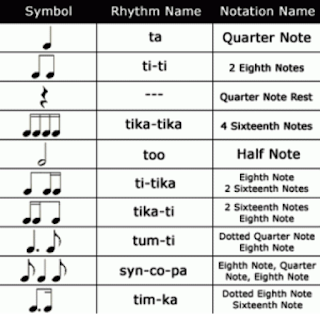
So, here is the last installment in this beginning set of Music Theory posts.   I know I’ve covered an awful lot in these last 3 posts but I promise you, if you’ll devote a little consistent time to learning it, the benefits you’ll receive will far outweigh your small time investment.   These key components of Music Theory make up the essential underpinnings of composed music.   The next set of Music Theory posts will cover different types of Chords, Scales, and Chord Progressions but until then, enjoy these amazing pillars of Music Theory and send me any questions you still have once you’re done.   Here you go: •             RHYTHMS AND TEMPOS - I try to explain the “Beat” of music or the “Rhythm” like our own heartbeat.   It is a regular, constant “pulse” (literally).   Most of the time this “Beat” or “Pulse” is what you dance to, tap your foot to, or clap along with. ...

Basic Music Theory - #2 - Clefs and Time Signatures

Image
Welcome to Music Theory Post #2 on the Grand Staff, Clefs, and Time Signatures, 3 incredibly important components of every musical composition.   I’ve included illustrations, which will, hopefully aid your understanding and comprehension of these concepts.   Please check these out and let me know what you think.   Here they are: •             CLEFS AND GRAND STAFF - When you SEE sheet music, the first thing you see are ten lines, grouped and separated into two groups of five with spaces in between.   On the left-hand side, are the Clefs.   These denote where the notes are to be played, which hand is to play which notes.   The “top” Clef is called the “Treble” of “G” Clef.   You will see it below.   Where you see the “Curl” on the Clef, there is a line that runs through it.   This is the “G” line, the “G” above Middle “C”.   The Clef on the bottom is the “B...